
Gear Trainer: learn the clutch with your own feet
A free manual car simulator that is all about the pedals. Press the clutch, find the bite point, change from 1st to 5th and do a hill start without rolling back, with both feet on screen and the engine you can hear.
Four levels
Learn the pedals starts from the engine off and adds one idea at a time: what the clutch pedal does, picking 1st, the bite point, letting the clutch all the way up, stopping without stalling and changing up. Nothing is marked; every step says what is happening in the car and why.
Up through the gears is a drive from a standstill to 5th, then back down to 3rd for town and a stop at the line. Smooth changes score more, and the faults an examiner would mark (stalling, over-revving, labouring the engine, coasting) cost points.
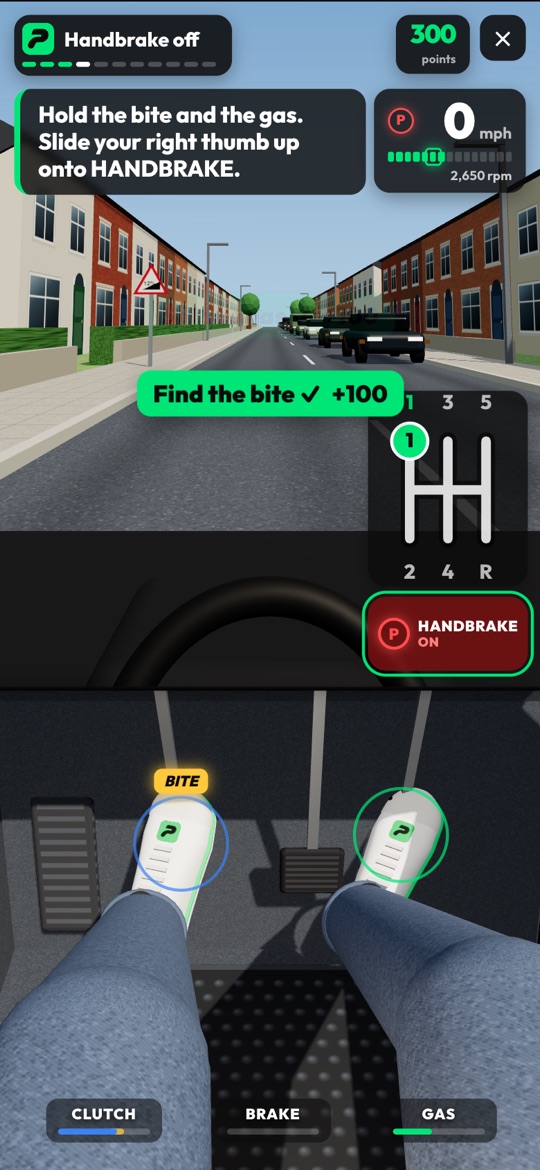
Hill start puts you on a 12% hill: set the gas, find the bite, handbrake off, go without rolling back. Then a stop on the hill and a second start with no help. Easy mode widens the bite point and holds the car for two seconds, like hill-start assist. The hill start opens with a free account, which also saves your scores and earns XP.
Steep hill is a 20% climb that needs a lot more gas and a slower clutch, for PassRank members.
How the clutch works, in one minute
The engine has to keep turning to run. The clutch sits between the engine and the gearbox: with the pedal down they are apart, so the engine idles while the wheels stand still. As you lift your left foot the clutch starts to connect them. That first point of contact is the bite point: the revs dip and the car wants to creep. Lift further and the two turn together.
Pulling away is that in slow motion: a little gas so the engine has something to give, the clutch up to the bite and held, then the rest of the way slowly while you add gas. Too fast and the engine is dragged below idle and stalls; too much gas and it screams while the clutch slips.
Which gear for which speed
Roughly, in a typical car. Listen to the engine as well as watching the speedometer: change up as it gets busy, down when it starts to struggle.
| Gear | Speed | Use it for |
|---|---|---|
| 1st | 0 to 10 mph | Pulling away and very slow traffic |
| 2nd | 10 to 20 mph | Junctions, tight turns, speed bumps |
| 3rd | 20 to 30 mph | Town roads, roundabouts |
| 4th | 30 to 40 mph | Faster town roads, 40 limits |
| 5th | 40 mph and up | Open roads, dual carriageways |
Hill start, step by step
- Clutch down, select 1st.
- A little more gas than on the flat: about 2,000 rpm.
- Lift the clutch to the bite: the revs dip and the bonnet lifts slightly. Hold your feet still.
- Check your mirrors and blind spot, then release the handbrake. The car should stay put.
- Lift the clutch a little more and add gas as you move off. If you start to roll back, more gas, or brake and start again.
On the test, rolling back a short way is usually a minor fault; rolling back a long way, or into the car behind, is serious. For the rest of the test, see the manoeuvre simulators and the most common driving test faults.
Questions
- Is the Gear Trainer free?
- Yes. Learn the pedals and Up through the gears are open to everyone with no account. A free PassRank account unlocks the hill start, saves your best scores and gives you XP on the weekly board for every run. The steep 20% hill is for PassRank members, along with the full 3D simulator.
- How do I press the pedals?
- Touch and hold a pedal and it goes down, the way your foot would push it. Let go and it comes back up. The clutch comes up slowly and stops for a moment with a click at the bite point, so you can catch it there. Slide your thumb up or down for fine control. On a computer, hold A for the clutch, W for the gas and S for the brake.
- What is the bite point?
- The bite point is where the clutch starts to connect the engine to the wheels as you lift your left foot. The engine note drops a little and the car wants to creep forward. Hold the clutch there with a little gas and you can pull away smoothly, or hold the car still on a hill.
- Why does a manual car stall?
- An engine needs to keep turning at around 800 rpm or more. If the clutch comes up too fast, or you stop in gear without pressing the clutch, the wheels drag the engine below that speed and it stops. More gas and a slower left foot fix the first; clutch down before you stop fixes the second.
- Is the bite point the same in every car?
- No. Every car's clutch bites at a slightly different height, and a worn clutch bites higher. What carries over is the feel: lift slowly until the revs dip and the car creeps. Find it in your own car in the first minute of a lesson.
- Do I need this for an automatic licence?
- No. An automatic has no clutch pedal. If you pass in an automatic, your licence only lets you drive automatics; pass in a manual and you can drive both.
Got the feet? Now drive it for real
PassRank has mock test routes from real test centres, the four manoeuvres and every kind of roundabout in a 3D simulator, in a manual or an automatic.
See PassRank